
What is Sym8?
- Sym8.EQ: Equilibrium chemical speciation
- Sym8.BK: Batch-type open and closed system time-dependent kinetic reactions modeling
The methodology used in Sym8 programs eliminates the basis species concept entirely. Instead, the user selects a set of elements and Sym8 assembles the complete complement of solutes and complexes from the thermodynamic database. The full set of equilibrium reactions and mass-balance conditions is then assembled into one mathematical system and solved simultaneously.
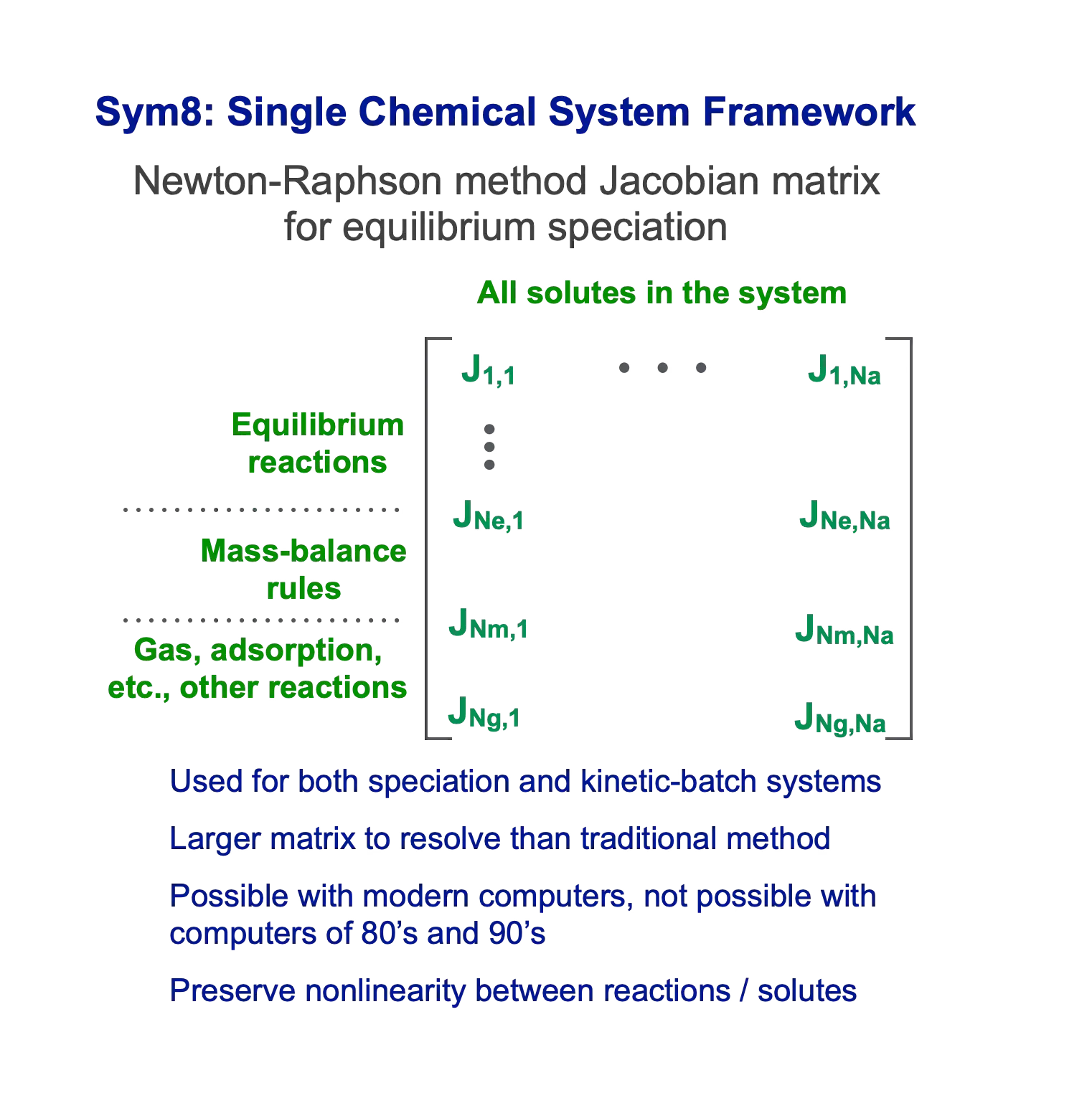
Sym8 uses a Newton–Raphson method to solve the complete chemical system simultaneously. The Jacobian matrix includes terms for every solute and every mass-balance condition. There is no separation between primary and secondary species, no reduced subsystem, and no basis swapping.
This means the Jacobian is larger than in traditional models, but modern computing handles that comfortably. In return, the system is mathematically simpler and more direct: one convergence criterion, one solve, no iterative coupling between subsystems.
Traditional speciation programs use a basis species framework
- A reduced set of primary (basis) species, one per chemical element
- All secondary species (complexes) are expressed algebraically as functions of the basis species
- The solver works on reduced NxN system, where N is the number of basis species
- The Jacobian (of Newton-Raphson numerical method) contains terms only for the basis species
- Secondary species are calculated from basis species concentrations
Sym8 methodology eliminates the basis species concept entirely
- Solutes are collected from database based on list of chemical elements selected for the chemical system
- All reactions and mass-balance conditions are assembled into one mathematical system
- The solver works on the complete NxN chemical system, where N is the number of solute species
Sept. 24, 2026:
Sym8.EQ v1.0.3 (beta) available for download
Full version release in mid-October
See subscription page for more detail
Sept. 01, 2025:
Version 1.0.2a available for download
Redox reactions, Stage 1:
Redox reactions and reaction pairs capable without the use of Nernst Equation;
User guide installed;
Improved user interface panels.
May. 19, 2026:
Sym8.EQ download site is offline while version 1.0.3 is being prepared
Sym8.BK beta: release expected in July-August time frame
Sept. 01, 2025:
Version 1.0.2a available for download
Redox reactions, Stage 1:
Redox reactions and reaction pairs capable without the use of Nernst Equation;
User guide installed;
Improved user interface panels.
June 5, 2025:
User interface panels adjusted;
Database modified to include thermodynamic properties of solutes, in preparation of redox (Nernst Equation) usage
March 25, 2025:
Version 1.0.0 available for download
| Reaction Type | Sym8 Approach | Traditional Approach |
|---|---|---|
| Aqueous complexation | Singular Jacobian matrix | Reduced basis-species Jacobian; secondary solutes calculated separately |
| Gas-water exchange (Henry's Law) | Singular Jacobian matrix | Separate phase, outer iteration loop |
| Adsorption / surface complexation | Singular Jacobian matrix | Grafted onto basis framework; iterative coupling |
| Convergence criterion | Single criterion for the full system | Separate criteria for each subsystem |
Sym8.EQ Equilibrium Speciation Modeling
Sym8.EQ provides a framework for equilibrium speciation modeling based on elemental mass conservation and a direct solution of the complete chemical system.
Unlike traditional speciation programs that distinguish between basis species and secondary species, Sym8.EQ treats all dissolved species within a single chemical system framework. Chemical reactions, mass-balance conditions, and phase equilibria are solved simultaneously using a Newton–Raphson formulation expressed directly in terms of elemental conservation.
The Jacobian matrix includes contributions from aqueous complexation, mineral equilibria, gas–water equilibrium, adsorption, and redox reactions within the same nonlinear system. This structure preserves strong coupling between reactions and solutes and avoids the need for sequential correction steps during speciation.
Because the formulation is based directly on elemental mass conservation, the numerical structure remains consistent across a wide range of chemical systems, from dilute waters to concentrated brines
Sym8.BK (batch-kinetic, flexible open/closed systems) coming soon
A single chemical system framework
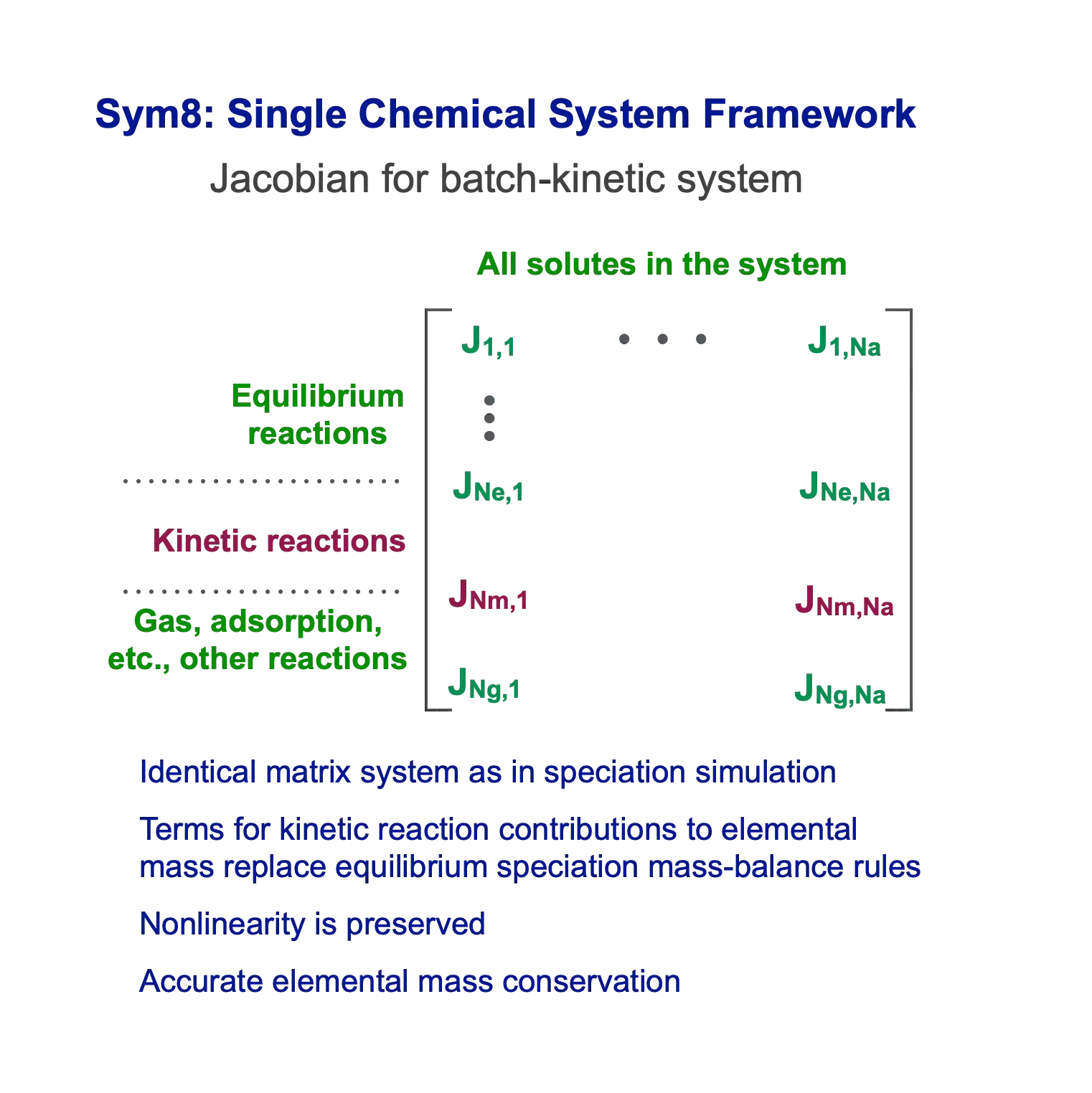
Like the equilibrium speciation engine in Sym8.EQ, Sym8.BK solves the complete chemical system using a Newton–Raphson method. The Jacobian matrix has the same structure as in equilibrium speciation; however, elemental mass-balance equations are replaced by terms describing kinetic contributions to elemental mass transfer between phases.
In conventional programs, kinetic reactions are evaluated separately and their effects are passed to the equilibrium speciation solver through updated elemental totals. This sequential workflow typically relies on operator-splitting methods. When gases, adsorption, or microbial reactions are included, their contributions must likewise be evaluated before speciation is recomputed.
In Sym8.BK, these processes are incorporated directly into the same Jacobian matrix and solved simultaneously within a single chemical system framework. This preserves strong nonlinear coupling between reactions and solutes and avoids timestep-dependent numerical artifacts that can arise in sequential approaches.
Combined with autonomous timestep control, this formulation allows Sym8.BK to resolve challenging water–rock interaction scenarios involving precipitation of new minerals, redox reactions, gas exchange, and strongly buffered systems that commonly introduce numerical instability in programs based on operator-splitting methods.
Sym8.EQ provides a Sym8.BK provides a modern framework for time-dependent geochemical reaction modeling. It is based on elemental mass conservation, a composite media model, and autonomous timestep control.
Coupling chemistry with evolving media properties
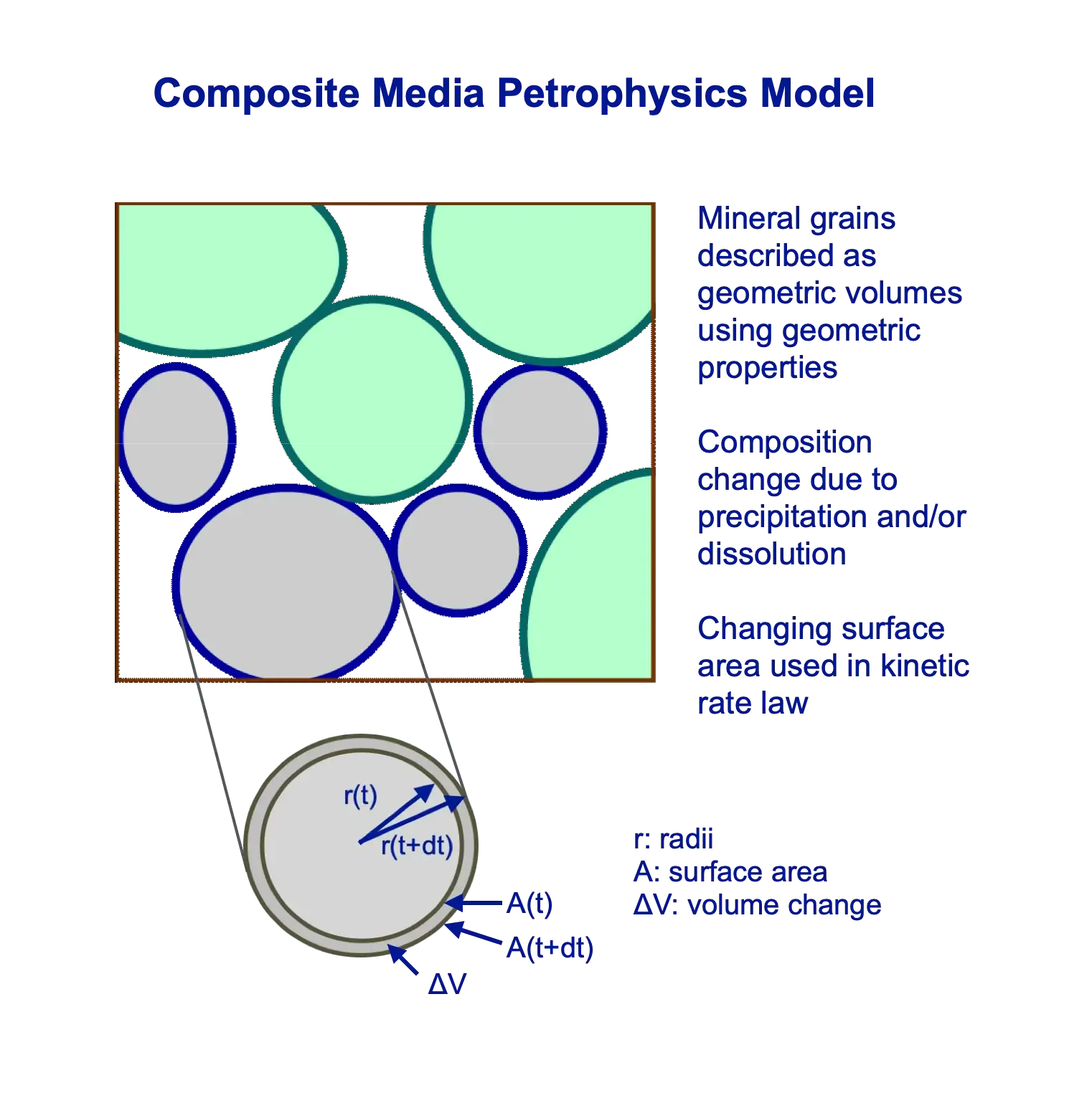
The composite media model represents sediments and rocks through mineral composition and grain geometry.
Each mineral phase is described using idealized grain shapes (such as spheres), allowing individual grain volumes and surface areas to be quantified. Mineral abundance is represented through grain number density (number of grains per unit volume).
Reaction rates determine mineral precipitation and dissolution volumes. In turn, the media model updates mineral surface areas, which directly control subsequent reaction rates.
Changes in grain volume are calculated from reaction rates, total surface area, and timestep size. As grain geometry evolves, surface area is updated accordingly and used in the next timestep’s reaction calculations.
This two-way coupling allows mineral geometry and reactivity to evolve consistently throughout the simulation.
Timesteps are adjusted automatically to monitor changes in both solute concentrations and mineral volumes, ensuring strict elemental mass conservation throughout the calculation.
The grain geometric and compositional data is then used to compute a large set of sediment/rock (petrophysical) properties, such as porosity, density, permeability, tortuosity, thermal properties, etc. These properties change as simulations continue.
This approach provides a physically consistent connection between mineral transformation, reactive surface area, and evolving water chemistry.
During a simulation, the chemical reaction model is solved together with a composite media model that tracks mass transfer between aqueous and solid phases.
Open and closed system behaviors
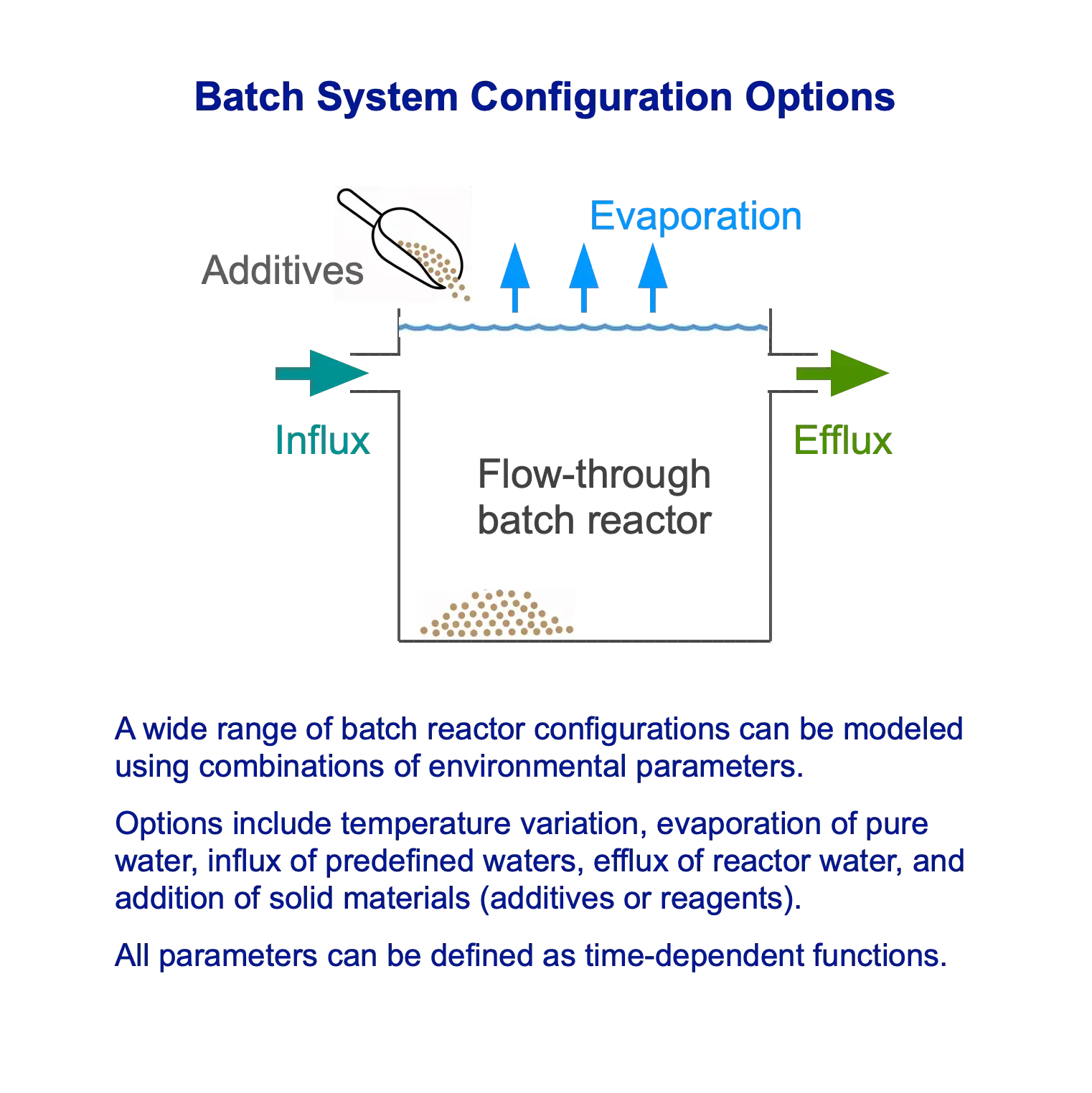
Sym8.BK can simulate closed batch and open flow-through reactor systems. In closed systems, the total elemental mass remains fixed throughout the simulation. In open systems, exchange with the environment may include interaction with an overlying air space (finite or open headspace), influx and efflux of water, evaporation of pure water, temperature changes, and addition of solid materials during the simulation.
Gas exchange is incorporated using Henry’s-law relationships that couple dissolved and gas-phase components. Changes in solute mass associated with water flux and evaporation are evaluated directly through elemental mass-conservation accounting. The model continuously tracks the total elemental inventory of the system and updates the chemical state accordingly as material enters or leaves the batch reactor.
In programs using conventional algorithms, evaporation and mixing are typically represented as sequences of discrete adjustment steps followed by separate equilibrium speciation calculations. Chemical reactions are therefore evaluated only after each imposed change in system composition. In contrast, Sym8.BK treats mass transfer, equilibrium reactions, and kinetic reactions together within one formulation, allowing coupled processes such as precipitation during evaporation, redox evolution during mixing, and simultaneous gas–water interaction to be modeled consistently throughout the simulation.
Because Sym8.BK is formulated entirely on an elemental mass-balance basis, elemental mass is conserved exactly through all chemical and physical processes, including equilibrium reactions, kinetic reactions, gas exchange, mixing, and evaporation. These processes are solved together within a single integrated formulation, allowing the chemical system to evolve continuously and consistently throughout the simulation period.
Sym8.BK can be configured to simulate closed batch, or open flow-through batch reactor systems
Relational Thermodynamic and Material Properties Database
Simplify chemical and physical database utilization and management
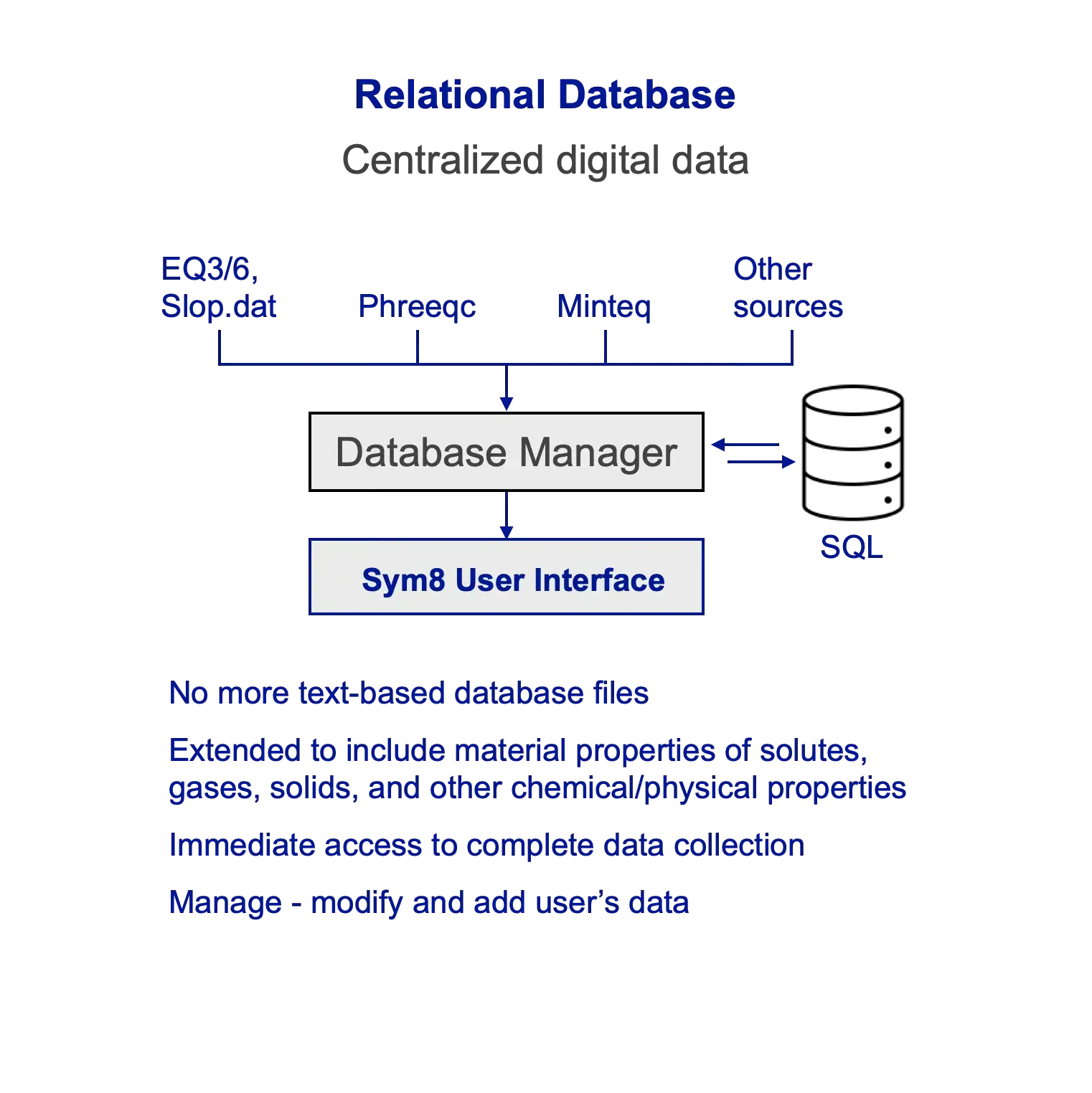
Unlike traditional water–rock interaction programs that rely on distributed text-based databases, Sym8 stores thermodynamic data in a centralized relational framework that allows species definitions, reactions, and associated properties to be accessed consistently across equilibrium and kinetic simulations.
Because all essential data are stored as linked database objects rather than independent text entries, the same dataset can be used seamlessly across speciation modeling and kinetic simulations. This provides a consistent foundation for constructing complex chemical systems while maintaining a transparent connection between model inputs and numerical formulation.
A dedicated database manager allows users to view, modify, and extend thermodynamic and model parameter data directly within the relational framework. All data items can be inspected and updated from this dedicated graphical user interface. New species, reactions, and parameter sets are incorporated directly into the database through the same relational structure.
Sym8 uses a relational database to organize all chemical and physical data and properties within a single structured system
Sym8.1D/2D coming in 2027
Reactive-transport using elemental mass-balance methodology combined with
Heat flow (advective and conductive) and
Multiple fluid flow options (Darcy flow or pressure-driven)
More details forthcoming later this year